

In July of 2021 I was approached by a builder who had a client who thought she could use part of her garden for a building plot. She had employed an architect to draw up an initial scheme and had submitted the scheme to Guildford Borough Council planning department as a pre-application.
The site was in a garden of a dwelling just outside the ‘defined’ village of Gomshall, in the Green Belt and an AONB.
This was the response: –
Policy P2 of the Council’s Local Plan: Strategy and Sites, 2015-2034, sets out what constitutes limited infilling. At paragraph 4.3.23 of the reasoned justification it states: · “For the purposes of this policy, limited infilling is considered to be the development of a small gap in an otherwise continuous built-up frontage, or the small-scale redevelopment of existing properties within such a frontage. It also includes infilling of small gaps within built development. It should be appropriate to the scale of the locality and not have an adverse impact on the character of the countryside or the local environment.” ·
The application site is not located within a built-up frontage, it is underdeveloped on more than one side, having only built development to the south and west of the site. Despite its proximity to the village and other residential dwellings the site has a different character, being set far back from the highway occupying a secluded site that borders an area of woodland and is surrounded by significant vegetation.
By virtue of the site not lying within a built up frontage and not being substantially surrounded by built form results in the conclusion that the proposed construction of a new dwelling in this location would represent inappropriate development in the green belt. The proposal would not comply with any of the exceptions set out in the NPPF, reiterated by policy P2, and is unacceptable.
The proposed development would represent inappropriate development in the green belt, which represents an ‘in principle’ objection to development, and therefore I would not recommend that you continue to pursue such a development proposal.
As a planning consultant and architectural designer who specialised in ‘Green belt’ applications he thought I could give her advice on whether it was worth the cost of pursuing this.
I had previously worked in Gomshall and was aware that there was a similar proposal on the other side of the village that had been refused and gone to appeal, which GBC had subsequently lost.
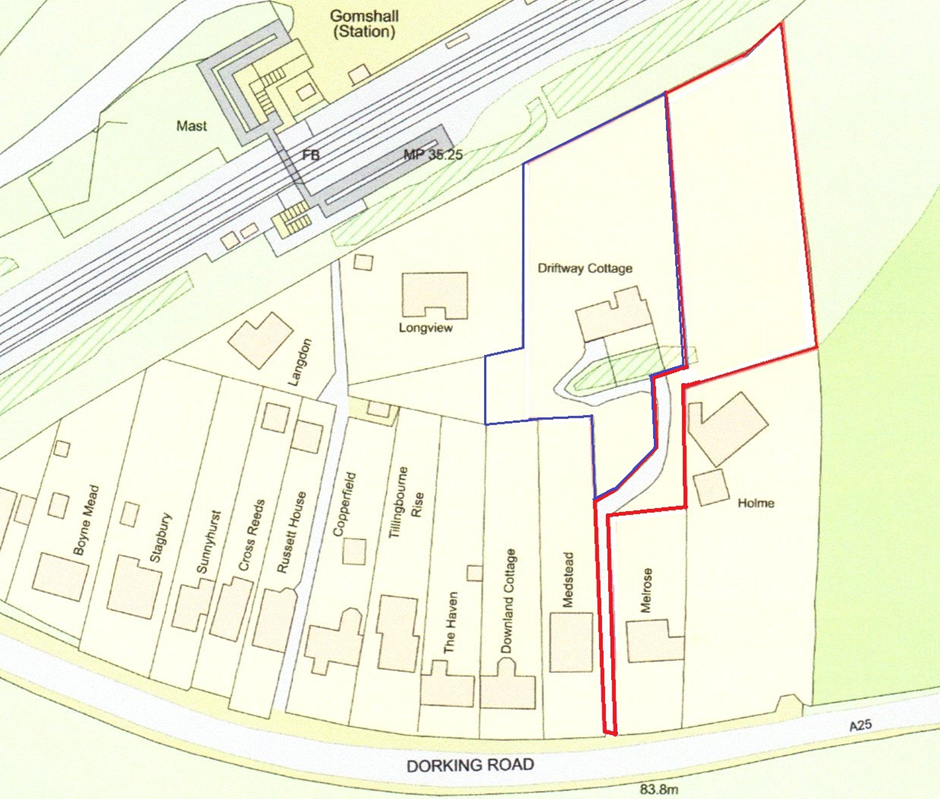
The points I made to her were: –
Positive points in favour of development:
• Infill is not defined within the Framework (NPPF), however the supporting text of Policy P2 of the LPSS provides local interpretation. This defines infill in 3 ways: ‘development of a small gap in an otherwise continuous built-up frontage’, ‘the small-scale redevelopment of existing properties within such a frontage’, or ‘infilling of small gaps within built development’.
• In the appeal for Old Drive, Gomshall (application Ref 18/P/01895), which is in a similar position at the west end of Gomshall, the inspector states ‘I note that with regard to the third definition, ‘within’ is not specifically defined, providing reasonable scope for interpretation.’ And goes on to state ‘The site as such appears as an obvious gap within the established layout of dwellings either side of Old Drive. Infilling would indeed square off the existing pattern without entailing any perceived extension of the existing built-up area of Gomshall. As such I find that the appeal scheme would constitute the infilling of a small gap within built development, as defined by the supporting text of Policy P2 of the LPSS.’ The outcome pf this appeal is, I believe, a very positive reason for the council to have to accept development at Driftway Cottage.
• The proposal would contribute a residential unit to the housing market and the district’s wider housing supply.
• Gardens outside towns should be considered as ‘previously developed land’ – Dartford Borough Council v Secretary of State for Communities and Local Government [2016] EWHC 635 (Admin) (“the Dartford Case”)
• The revised NPPF was published in July 2018. Paragraph 11 sets out the presumption in favour of sustainable development and identifies the implications for both plan making and decision taking. For plan making this means that Councils ‘should positively seek opportunities to meet the development needs of their area’. For decision taking this means ‘granting permission unless there is a clear policy reason for refusing the development proposed or impact of doing so would significantly outweigh the benefits.’
My client agreed and we commence the design and planning work to achieve a new dwelling in her garden.